Close the year with figures everyone reads the same way, and open the next one already knowing them. Each figure has a before, an after, the document that proves it and a grade that says how far it holds in front of finance.
What changes
Cost saving and cost avoidance get added into one total, closure reports get rebuilt by hand, and every market reads spend its own way. AURA writes the closure from the lines it already holds and keeps the two figures apart, each with its baseline, its evidence and its grade. Finance validates what shows in the final accounts; procurement defends the method line by line; marketing shows what was protected (the director, the shooting days, the quality) and what was obtained on top; the board reads one year against the last.
What was measured becomes the baseline of what comes next.
Closure
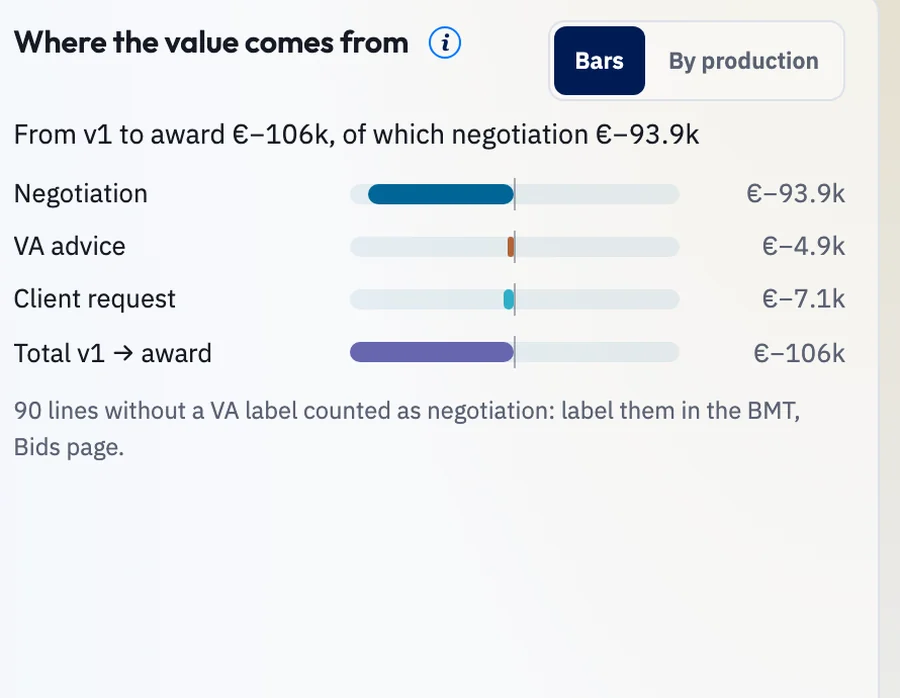
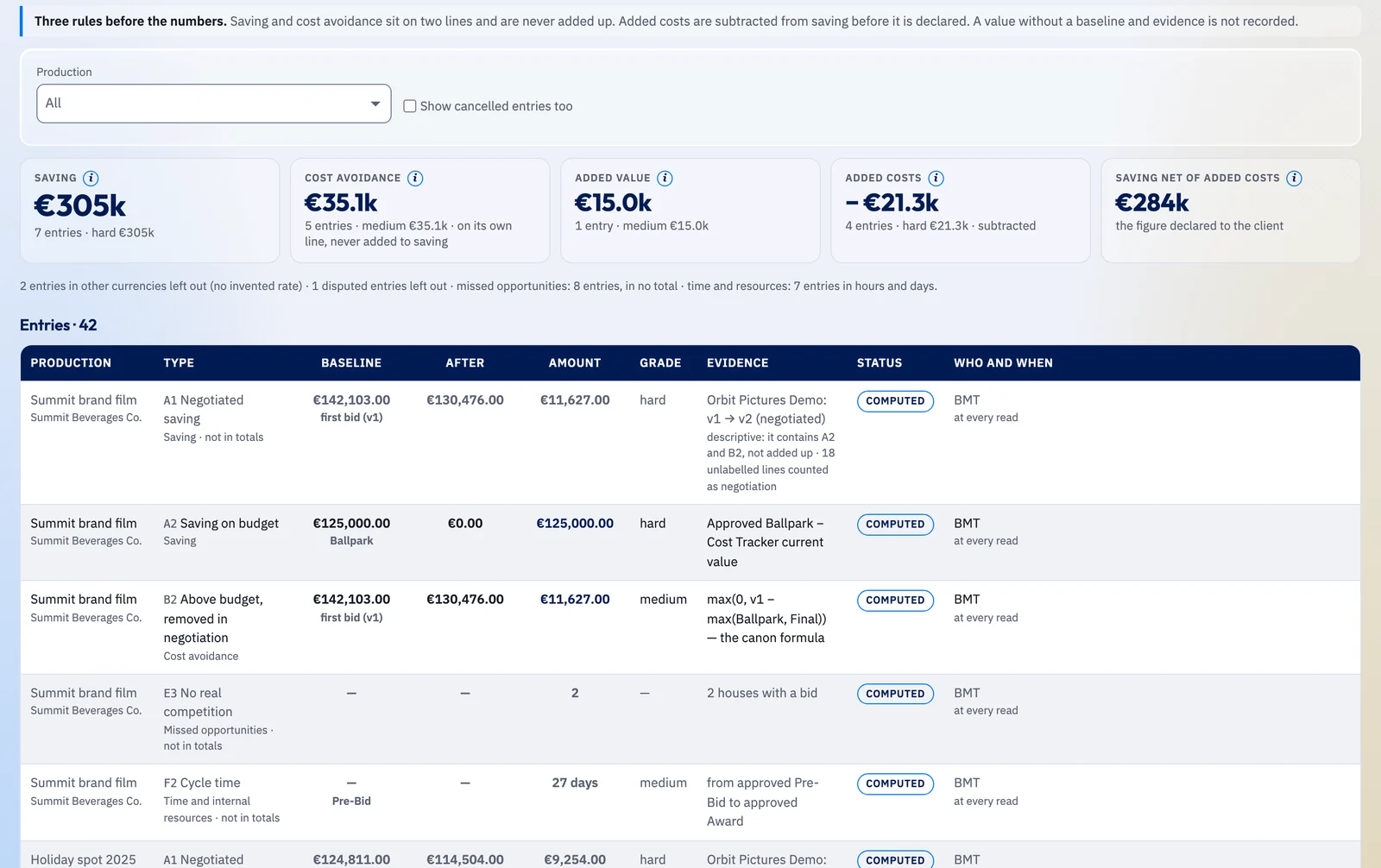
AURA writes a closure report for every engagement, from the first figure to the final cost. Cost saving (spending less than the budget at hand) and cost avoidance (a cost that never happened) stay on two lines and are never added up. Costs added on purpose, for quality or for a change of brief, are shown and subtracted before anything is declared. Each figure traces to the cost line it comes from, with its version, its date and its author, and carries a grade: hard when it shows in the final accounts, medium when it is documented, soft when it is a declared estimate. Time your team gained stays in days; quality protected stays on a scale, never turned into money.
Dashboards
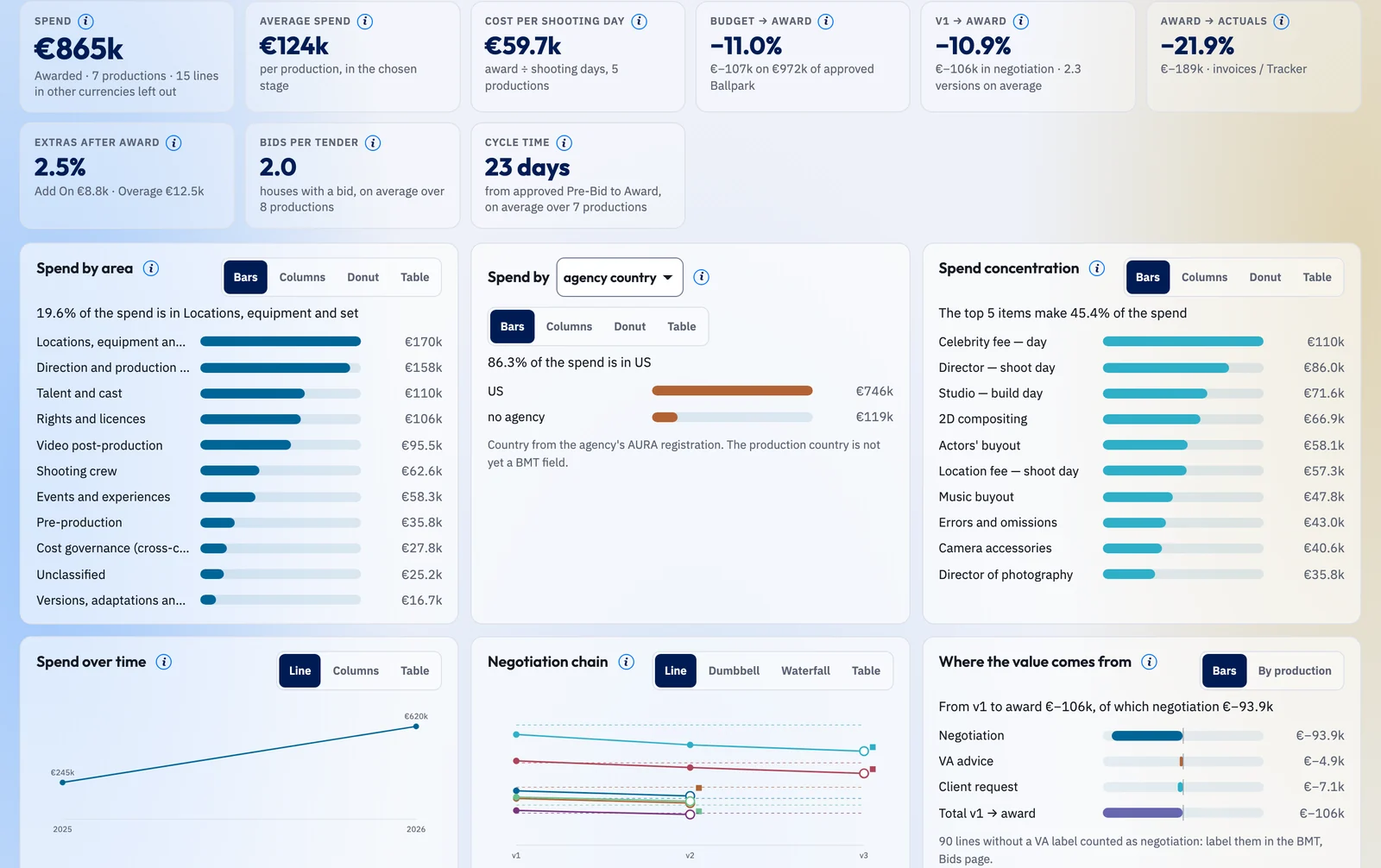
Every project, campaign, estimate and final cost is classified as it is saved. AURA reads the result by category, market and vendor, the same way every year, so the next benchmark and the next plan start from your own figures. A brand with one market reads one line; a portfolio across regions reads the same line thirty times, in one currency, with every market still visible.
Behind every function
Every closure in AURA is read against what VA has governed and measured since 1994, across every stage, worldwide: what a production, a fee or a pitch costs when it is managed well, from one brand in one market to a global portfolio. That is the reference a client’s own figures become part of, year after year, and VA’s fee is never a share of them.
of marketing spend reviewed
projects reviewed
suppliers assessed and classified
pitches managed every year
Who does what
Where it sits
Keep what was agreed and what is delivered on the same line.
Close the year with figures everyone reads the same way.
See how the model works today, before changing it.
Questions
Because they are two different things. The saving shows in the final accounts; the avoidance shows in what did not happen. Added up, the figure does not survive a conversation with finance.
How far it holds in front of finance. Hard: it shows in the final accounts or in a signed document. Medium: it is documented, but not in a final account. Soft: a declared estimate. A total with its grades can be defended line by line; a total without them can be contested as a whole.
Yes. Each figure traces to a cost line, with its version, its date, its author and its grade.
No. The closure reads whatever was recorded in AURA, from one production to a full year of engagements.
No. A closed project stays readable and is never modified; a correction is a new entry with its own date.
Get a demo
A walk through Performance Measurement in AURA with the VA team, on your own case: one brand in one market, or a global portfolio.